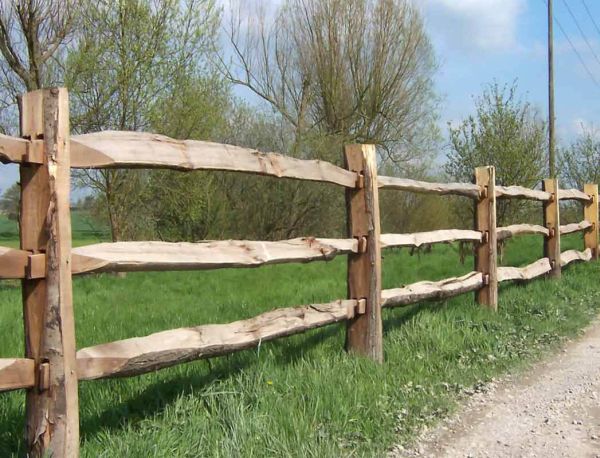
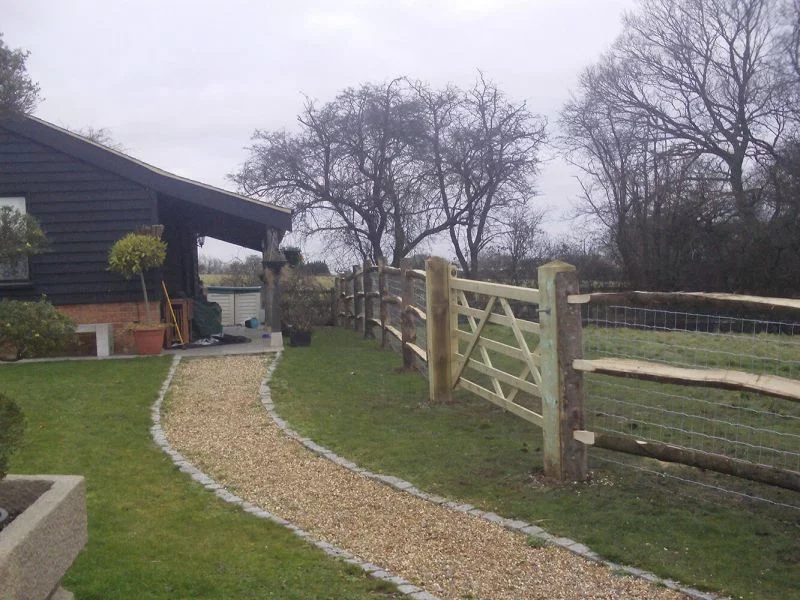
Produced from locally sourced sweet chestnut, mortised and with rails that are split rather than sawn, each piece of fencing is unique & has natural character.
Post and Rail fencing is known for its rustic, natural appearance, perfect for areas where subtlety is essential.
If necessary, the discreet addition of stock wire or rabbit netting means that your Post and Rail fencing will also contain pets.
-
Aesthetic Appeal:Cleft chestnut fencing offers a unique & attractive rustic appearance that can complement any outdoor space. This style of fencing is popular because it's very natural looking and doesn't have the manmade feel that many other types of fencing have.
-
Long-lasting:The split wood used in cleft chestnut fencing is a native hardwood, durable & rot-resistant, providing a long-lasting fencing solution that doesn't ever need treating but typically has a 20-year plus-lifespan.
-
Environmentally-friendly:Cleft chestnut fencing is an eco-friendly option since it is locally sourced, has no treatment & few delivery miles.
-
Versatile:Cleft chestnut fencing can be used for various applications, including boundary fencing, agricultural fencing & garden fencing.
-
Low maintenance:Cleft chestnut fencing requires no maintenance; as a native hardwood, it will last for 20-plus years with no treatment.

Request a quote
- As a leading supplier and contractor, we specialise in high-quality agricultural and commercial fencing solutions.
- We Have Many References From Previous Clients, Including Local Authorities, Schools, Government Agencies, Businesses & Private Clients
- Committed to excellence, we use premium UK-sourced materials built to last.
- Contact us today for a free, no-obligation site visit and quote.
Cleft chestnut fencing is a traditional, attractive and highly versatile fencing solution for country gardens, paddocks, parkland, farms, smallholdings and other rural properties. Its naturally irregular shape and warm timber tones allow it to blend beautifully into the surrounding landscape, creating a clearly defined boundary without the uniform, manufactured appearance of many modern fencing systems.
Produced from locally sourced sweet chestnut, each post and rail has its own natural character. Rather than being sawn into identical boards, the rails are split along the natural grain of the timber to create strong, distinctive components with an authentic rustic finish.
For property owners seeking fencing that combines longevity, sustainability and timeless rural appeal, cleft chestnut post and rail fencing is an excellent long-term investment. It is particularly well suited to locations where the fencing must perform reliably while complementing the character of the surrounding landscape.
Farm & Country Fencing supplies and installs bespoke cleft chestnut fencing throughout Hertfordshire, Essex and the surrounding areas, with every installation tailored to the individual property and its intended use.
Cleft chestnut fencing is a traditional post and rail fencing system manufactured from naturally durable sweet chestnut timber. It is widely used for paddocks, farms, country estates, parkland, woodland, gardens and rural boundaries where a natural appearance and long service life are equally important.
The word "cleft" refers to the way the rails are split along the timber's natural grain rather than being sawn into completely uniform sections. Following the grain creates the distinctive rustic appearance for which traditional cleft chestnut fencing is known.
The rails are typically fitted into morticed posts to create a strong and visually attractive fencing system. Farm & Country Fencing offers cleft chestnut or oak post and rail fencing in both two and three rail configurations, using cleft or sawn double-morticed posts depending on the chosen specification.
Because every piece of timber grows and splits differently, no two sections are exactly alike. Natural variations in shape, texture, grain and colour are all part of the authentic character of the product rather than imperfections.
Cleft chestnut fencing is particularly popular for:
- Country gardens and rural homes
- Farms and smallholdings
- Paddocks and grazing land
- Country estates and parkland
- Woodland boundaries
- Heritage and period properties
- Public open spaces and rural developments
Sweet chestnut is a durable hardwood that has been used in outdoor construction for centuries. Unlike many softwood fencing products that rely on pressure treatment for longevity, quality sweet chestnut contains naturally durable heartwood that is well suited to external use.
This makes the timber particularly suitable for posts, rails and other fencing components that remain exposed to the British weather throughout the year.
When correctly selected, professionally installed and used in suitable site conditions, cleft chestnut fencing can typically provide a service life of 20 years or more. The exact lifespan will depend on factors such as drainage, ground conditions, exposure, installation quality and ongoing care.
Over time, the timber naturally weathers from its warm golden-brown colour to an attractive silver-grey. Many property owners consider this one of sweet chestnut's most desirable characteristics, as it allows the fencing to blend even more naturally into established rural landscapes.
One of the defining advantages of cleft chestnut fencing is that its durability comes naturally from the timber itself.
Unlike fencing manufactured from less durable timber species, sweet chestnut does not normally require pressure treatment or routine applications of wood preservative. This allows the timber to retain its authentic appearance without introducing unnecessary chemical treatments into gardens, paddocks, woodland or environmentally sensitive locations.
This makes cleft chestnut fencing particularly suitable for:
- Rural and agricultural land
- Nature reserves and conservation projects
- Woodland and parkland
- Country gardens
- Heritage landscapes
- Environmentally conscious developments
Although sweet chestnut fencing does not normally require painting, staining or preservative treatment, periodic inspections remain good practice. Vegetation should not be allowed to place prolonged pressure on the rails, and any accidental damage should be repaired promptly.
For customers looking to reduce their environmental impact, cleft chestnut fencing is an excellent choice.
Sweet chestnut has traditionally been managed through coppicing, a long-established woodland management technique where trees are cut close to ground level and allowed to regrow naturally from the existing stool. This enables the same woodland to produce repeated crops over many years without replanting.
Using locally sourced sweet chestnut can also reduce transport distances while supporting British forestry, traditional woodland management and rural craftsmanship.
Cleft chestnut fencing offers several environmental benefits:
- Produced from a renewable natural material
- Sweet chestnut can be managed through coppicing
- Does not normally require chemical preservative treatment
- Local sourcing can reduce transportation distances
- Long service life reduces replacement frequency
- Untreated timber is biodegradable at the end of its useful life
Its longevity also contributes to its sustainability, reducing the need for frequent replacement and minimising material use over the lifetime of the fence.
Cleft chestnut fencing is valued not only for the timber itself but also for the traditional way in which it is produced.
Rather than sawing every rail into identical dimensions, the timber is split along its natural grain. This creates the distinctive undulating lines and organic appearance associated with traditional cleft chestnut fencing.
Every rail displays its own knots, grain patterns and natural variations, giving each installation genuine character and individuality.
This makes cleft chestnut particularly well suited to rural properties where highly processed or industrial-looking fencing would feel out of place. It creates a softer visual boundary that complements woodland, meadows, traditional buildings and mature landscaping.
Cleft chestnut fencing is an extremely versatile solution suitable for a wide range of rural, agricultural, residential and commercial applications.
Farms and Smallholdings
Its strong construction and traditional appearance make it ideal for farms and smallholdings where practical boundaries need to complement the surrounding landscape. Stock wire can also be incorporated where additional containment is required.
Paddocks and Grazing Land
The post and rail design clearly defines paddocks and field boundaries without creating an imposing solid barrier. The specification can be tailored to suit the animals being managed.
Equestrian Properties and Livery Yards
Cleft chestnut fencing offers an attractive way to divide land around equestrian properties and livery yards. Where fencing is intended for horses or ponies, the rail configuration, height and any supplementary wire should always be selected for the specific application.
Country Gardens
The natural appearance of cleft chestnut fencing enhances country gardens, cottage gardens and larger rural properties while preserving an open feel.
Country Estates and Parkland
Its timeless appearance makes it particularly suitable for country estates, manor houses and parkland where maintaining the character of the landscape is important.
Woodland and Conservation Sites
Because sweet chestnut is naturally durable and normally requires no preservative treatment, it is particularly well suited to woodland paths, conservation projects and environmentally sensitive sites.
Heritage and Period Properties
Traditional cleft chestnut fencing complements older buildings and established landscapes far more sympathetically than many modern fencing systems.
Parks and Commercial Landscapes
It is equally suitable for parks, schools, visitor attractions, hospitality venues and other public-facing properties where presentation and durability are equally important.
The open nature of post and rail fencing is ideal for defining boundaries, but some applications require greater containment.
Where appropriate, cleft chestnut fencing can be combined with stock wire or rabbit netting while maintaining its traditional appearance.
This can be beneficial for:
- Livestock containment
- Dogs and domestic pets
- Rabbit exclusion
- Protecting gardens and planted areas
- Agricultural field boundaries
During your free site survey, we'll recommend the most appropriate wire specification for your particular application.
Farm & Country Fencing offers both two rail and three rail cleft chestnut or oak post and rail fencing.
A two rail system creates an attractive open boundary, making it ideal for gardens, parkland and larger landscapes.
A three rail configuration provides a more substantial boundary and is often preferred for paddocks, farms and agricultural applications.
The most suitable option depends on:
- Intended use
- Animals being contained
- Desired height
- Property style
- Ground conditions
- Whether additional wire or netting is required
Every installation is designed around the individual property rather than following a one-size-fits-all approach.
Both cleft chestnut and pressure-treated softwood can provide practical fencing solutions, but they offer very different appearances and long-term characteristics.
Cleft chestnut is chosen for its naturally durable hardwood timber, traditional craftsmanship and authentic rural appearance. Its split rails create a unique finish that blends beautifully into countryside settings.
Pressure-treated softwood is generally more uniform in appearance and relies on preservative treatment to improve durability.
Many customers choose cleft chestnut fencing because it offers:
- A naturally rustic appearance
- Durable hardwood timber
- No routine requirement for pressure treatment
- Excellent compatibility with rural landscapes
- A typical lifespan of 20 years or more in suitable conditions
- Attractive natural weathering over time
During your free site survey, we'll help you decide which fencing solution is best suited to your property, budget and intended use.
Every property is different, which is why every cleft chestnut fencing project is individually designed.
Depending on your requirements, your installation can incorporate:
- Two or three rail configurations
- Cleft or sawn double-morticed posts
- Sweet chestnut or oak components
- Pedestrian and field gates
- Stock wire
- Rabbit netting
- Changes in height
- Sloping ground solutions
- New paddock or field divisions
Our experienced team will recommend the most appropriate specification based on your property, intended use and long-term requirements.
Fencing is often one of the most visible features of any rural property.
The warm tones and natural texture of cleft chestnut create an attractive alternative to highly processed timber, metal fencing or solid panels.
Professionally installed cleft chestnut fencing creates an attractive first impression for visitors, customers and prospective buyers while complementing traditional architecture and mature landscapes.
As the timber naturally weathers, it becomes even more sympathetic to its surroundings.
Although all outdoor fencing benefits from periodic inspection, cleft chestnut fencing requires relatively little ongoing maintenance.
The timber does not normally require painting, staining or pressure treatment, helping to reduce long-term maintenance costs.
To maximise its lifespan:
- Remove excessive vegetation around the fence
- Check periodically for accidental damage
- Maintain gates correctly
- Monitor drainage around fence posts
With professional installation and routine care, cleft chestnut fencing provides outstanding long-term value.
Even the highest quality materials rely on professional installation to achieve their full lifespan.
Correct post spacing, suitable foundations, accurate rail fitting and careful consideration of ground conditions all contribute to a durable and attractive finished fence.
Our experienced installers understand the practical challenges of agricultural, rural and residential fencing, ensuring every installation is completed to the highest standard.
Farm & Country Fencing installs cleft chestnut fencing throughout Hertfordshire, Essex and the surrounding areas.
We work with homeowners, farmers, equestrian properties, country estates, schools, businesses and local authorities, delivering bespoke fencing solutions designed around every individual site.
When you choose us, you benefit from:
- Free site surveys
- No-obligation quotations
- Bespoke fencing designs
- High-quality sweet chestnut materials
- Professional installation
- Options for gates, stock wire and rabbit netting
- Extensive agricultural and rural fencing experience
- Reliable local service
Every project is carefully planned to deliver the perfect balance of appearance, durability and long-term value.
What is cleft chestnut fencing?
Cleft chestnut fencing is a traditional post and rail fencing system made from naturally durable sweet chestnut timber, with rails split along the natural grain to create its distinctive rustic appearance.
How long does cleft chestnut fencing last?
When professionally installed in suitable conditions, quality cleft chestnut fencing can typically last 20 years or more.
Does sweet chestnut fencing need treating?
No. Sweet chestnut is naturally durable and does not normally require pressure treatment, painting or staining.
What does "cleft" mean?
"Cleft" refers to timber that has been split along the natural grain rather than sawn into uniform sections.
Is cleft chestnut fencing environmentally friendly?
Yes. Sweet chestnut is a renewable natural material that can be coppice-managed and normally requires no chemical preservative treatment.
Can stock wire be added?
Yes. Stock wire and rabbit netting can be incorporated where additional containment is required.
Is it suitable for paddocks?
Yes. It can be used for paddocks and grazing land, with the specification tailored to the intended animals.
Can it be installed on sloping ground?
Yes. Every installation is designed around the contours and conditions of your property.
Do you provide free site surveys?
Yes. Every project begins with a free, no-obligation site survey and quotation.
What areas do you cover?
We install cleft chestnut fencing throughout Hertfordshire, Essex and the surrounding areas.